Back to the Future 2 Review
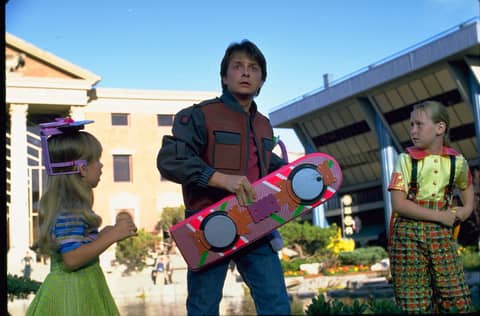
Sequels are a dangerous game. Every now and then, one comes along that not only lives up to the original, but actually dares to do something bigger, bolder and more bonkers. Back to the Future 2 is precisely that kind of sequel. It arrives with enormous pressure, riding the hoverboard-shaped wake of one of the most beloved films of all time, and then says, "Stuff it, let's go again, but weirder.” We really enojoyed our Back to the Future 2 review, so much that we wrote about it as well.
As the boys said in the episode, following up on an icon like Back to the Future is almost impossible. The studio threw the curveball of all curveballs by ending the first film with the “To Be Continued” tag, instantly guaranteeing the hype machine would be revving harder than a DeLorean with a nuclear core. And stepping into that pressure cooker is exactly where Part 2 thrives. It swings big. It takes risks. It may not be as slick as the original, but it might actually be more fun.
“This movie was always just… there.”
One of the great charms of the Back to the Future franchise is its omnipresence. For both Gow and Will in the transcript, Part 2 wasn’t discovered so much as absorbed. It was always on TV, always being rewatched, always popping up in some form. It sat in the background of childhood like furniture. You didn’t decide to watch it, you just realised you’d already seen it 15 times.
Whitey backs that up with his own personal history—seeing it at the movies and loving it more than the original as a kid. And honestly, that checks out. As a youngster, Part 2 is the more exciting entry because it’s visually wild, narratively manic and stuffed with more ideas than most trilogies manage across three films. Hoverboards, flying cars, dehydrated pizza, future Nike sneakers, a sports almanac, and Biff Tannen looking like he moonlighted as a stunt double for Donald Trump.
Sure, adulthood tends to shift most viewers back toward the emotional tightness of the original, but nothing takes away from the thrill ride of this sequel.
The 2015 future — ridiculous in all the right ways
Whenever discussion of the film lands on the depiction of 2015, it always ends in a combination of admiration and laughter. The transcript nails the sentiment: “This isn’t supposed to be a real time-travel movie, it’s a fun movie.”
This is why the makeup looking a bit questionable works. This is why no one, except Neil deGrasse Tyson, bothers poking scientific holes in it. The movie wears its silliness proudly, and that is exactly why it’s aged so well. It's a heightened comic-book version of the future, not a prediction. Hoverboards, self-tying shoes, and Café 80s aren’t attempts at accuracy; they’re attempts at joy.
And for all the hype hoverboards get, the real MVP of the future scenes might be Mr Fusion, the casual household rubbish-fuelled nuclear reactor strapped to the back of the DeLorean. The transcript’s kick-ass credit song jokes about it, "Mr Fusion, hungry for the junk", which sums it up perfectly. Part 2 is a film where even the gadgets have punchlines.
The Jennifer problem or the Elizabeth Shue problem
One of the funniest tangents from the episode is the discussion about Jennifer suddenly being played by Elizabeth Shue. It’s one of the more infamous examples of recasting in a franchise, and the boys treat it exactly the way it deserves: with absolute silliness.
“There's a new Jennifer who’s prime for the stuffing,” sings Whitey in the episode's credit song, leaning into the absurdity of the recasting and the awkwardness of Jennifer being a mostly unnecessary character who gets knocked out in the first 10 minutes. But Shue is part of the charm of the sequel, t’s one of those quirks that only makes people love the film more over time.
When the film turns dark, the alternate 1985
If the future section is comedic madness, the alternate 1985 section is the exact opposite. Suddenly, Hill Valley becomes a dystopian nightmare where Biff Tannen has become a tyrannical casino lord, stuffing money, politics and plastic surgery into every corner of life.
This tonal shift was one of the boys' favourite talking points, because it’s such an unexpected and gutsy direction. Gow vividly describes audience anticipation; everyone who saw the original in 1985 was waiting for this movie. And Part 2 rewards that anticipation by saying, “Right, let’s completely break the universe and see what happens.”
The alternate 1985 works because Biff is so much fun; he’s a villain who’s ridiculous but also legitimately menacing. He’s the exaggerated embodiment of '80s greed, and watching Marty grapple with a world twisted by a single stolen sports almanac is one of the film’s smartest ideas.
Back to 1955: the most impressive part of the film
The transcript makes clear that the boys hugely respect the film’s technical achievement when Marty returns to 1955 and weaves through the events of the first film. It’s one of the earliest examples of a movie revisiting its own footage and re-staging iconic moments from new angles.
This was ambitious filmmaking for 1989. No CGI cheats, no digital compositing shortcuts. It’s filmmaking gymnastics, and it's pulled off with style. As Gow said, the moment the original theme plays again, you’re transported back immediately, right back to the world of the first film.
Doc and Marty: the real heart
One of the standout moments from the transcript is the discussion of who the “star of the show” is. Will clever picks Christopher Lloyd, noting he has more to do, while Gow and Whitey choose the Doc-and-Marty combination, the “one-two punch.”
They're right. This is the movie where their chemistry becomes legendary. Doc isn’t just the eccentric mentor anymore; he’s a full co-protagonist. The banter is better, the stakes are higher, and their dependency on each other is more emotionally grounded.
So, where does Back to the Future Part 2 sit in the sequel pantheon?
The episode lists the gold-standard sequels, The Empire Strikes Back, The Godfather Part II, Aliens, Terminator 2 and asks whether Part 2 belongs among them. The answer? Kind of. It’s not as polished or as universally revered as those giants, but it is far more inventive than most sequels ever attempt to be.
It refuses to be safe. It refuses to copy the original. Instead, it expands the universe, deepens the lore, and sets the stage for Part 3 in a way that feels organic.
And importantly, it’s a movie that families still watch together. As mentioned in the transcript, it’s one of those magic films that spans generations. Kids love it. Adults love it. Even people who haven't seen it since 1989 love it.
Final verdict
Back to the Future Part 2 may not be the best film of the trilogy, but it is arguably the most ambitious. It’s clever, chaotic, colourful and confident. It embodies everything a sequel should try to be: not a repeat, but an evolution.

The Video Shop Owner
Matt White, affectionately known as "Whitey" on the "Born to Watch" podcast, epitomises a cinematic sage. Classics like Star Wars, Jaws, and Willy Wonka and the Chocolate Factory sparked his passion for film at a tender age. These films not only captivated him but also moulded his path in life. While briefly flirting with creative arts himself, Matt soon realised his true calling was not in starring in or producing movies but in sharing them. This realisation led him to his true vocation as the guiding light for others’ film explorations.
Taking this passion to a professional level, Matt once owned a video rental store, turning a simple business into a thriving hub for movie enthusiasts. There, he did more than rent out films; he curated cinematic experiences. His shop became a local cornerstone where he imparted his vast knowledge, enthusiastically recommending films that catered to his customers' unique tastes.
Beyond the counters of his now-closed store, Matt's joy in movies is most vividly seen at home. Watching films with his kids, he delights in their reactions, finding profound satisfaction in passing on his love for movies to the next generation. On "Born to Watch," Whitey is more than a host; he’s a mentor, sharing his passion project with listeners and inviting them to join him on a journey through the world of film.
Hard to Kill Movie Review: Peak VHS Action or Peak Ego?